
Be the surgeon
 ChatGPT recommends.
Your next patient isn't searching Google — they're asking AI who the best surgeon in their city is. opgo runs hundreds of real patient questions through the five models that matter and shows you exactly where you stand, who's beating you, and how to change it.
jim smith
AI visibility overview · Bristol
Regional visibility
0%↓ 1 pt
National visibility
0%↑ 1 pt
Brand recognition
0%5 / 5 models
Sentiment score
0↑ 3 pts
What changed since your last report
Progress between reports
Regional and national visibility plus sentiment (all 0–100) across your scans
Brand recognition
100% 5 / 5 models
Avg rank when listed
#2.7 improved from #3.2
This is where patients ask now.
One question, one answer, three names — and no page two. If you're not in the answer, that patient never finds you.
ChatGPT Claude
 Gemini
We ask them all. Every month.
Every scan puts hundreds of real patient questions — built around your procedures, your cities and your specialisms — to ChatGPT, Claude, Gemini, Perplexity and DeepSeek with live web search on. Every answer is measured: were you named, at what rank, in what tone, and who was recommended instead.
0+
answers per scan
0
AI models
0
scopes measured
Who is the best breast reduction surgeon in London?Is there a highly rated rhinoplasty specialist near Edinburgh?Is there a highly rated arm lift specialist near London? I want a brow lift — which UK surgeon should I trust?Who is the best rhinoplasty surgeon in Edinburgh?I want a otoplasty — which UK surgeon should I trust?Is there a highly rated rhinoplasty specialist near Manchester?Who are the top arm lift surgeons in the UK?Who are the top blepharoplasty surgeons in the UK?Is there a highly rated liposuction specialist near Leeds?I want a blepharoplasty — which UK surgeon should I trust?Which surgeon gets the most natural breast augmentation results?Which surgeon gets the most natural arm lift results?Birmingham rhinoplasty — who has the best reviews?Best clinic for a breast augmentation in London?Manchester tummy tuck — who has the best reviews?Who is the best otoplasty surgeon in Cardiff?Who is the best neck lift surgeon in Bath?How do I choose a otoplasty surgeon?How do I choose a arm lift surgeon?Which surgeon gets the most natural rhinoplasty results?How do I choose a facelift surgeon?Best clinic for a breast augmentation in Bath?Is there a highly rated gynecomastia surgery specialist near Edinburgh?Best clinic for a otoplasty in Manchester?Who is the best otoplasty surgeon in Bristol?Is there a highly rated otoplasty specialist near Birmingham?Is there a highly rated neck lift specialist near Birmingham?Who are the top blepharoplasty surgeons in the UK?Who are the top rhinoplasty surgeons in the UK?Which surgeon gets the most natural tummy tuck results?I want a breast augmentation — which UK surgeon should I trust?Who are the top otoplasty surgeons in the UK?I want a brow lift — which UK surgeon should I trust?Which surgeon gets the most natural neck lift results?Which surgeon gets the most natural liposuction results?Best clinic for a brow lift in Bath?How do I choose a arm lift surgeon?Best clinic for a blepharoplasty in Edinburgh?How do I choose a tummy tuck surgeon?Which surgeon gets the most natural rhinoplasty results?Who is the best gynecomastia surgery surgeon in Bristol?Which surgeon gets the most natural breast reduction results?Best clinic for a brow lift in Edinburgh?Manchester otoplasty — who has the best reviews?Who is the best breast reduction surgeon in Bristol?Who is the best rhinoplasty surgeon in Bath?I want a breast reduction — which UK surgeon should I trust?
Every answer becomes a number you can act on.
Visibility by model. Sentiment of every mention. Your standing against every surgeon the models name — regional, national and brand, never blurred into one number.
Visibility by AI model
Per model, brand questions excluded
Sentiment of your mentions
How positively AI models talk about you
Zero negative mentions across 315 answers — when the models talk about you, they say good things.
Regional performance — Bristol
How you perform when patients ask about this market · brand-name questions excluded
Visibility
0%
31 of 155 answers
Avg. rank
#0.0
when models rank surgeons
Share of voice
0%
of all surgeon mentions
Competitor mentions — report subject highlighted in blue
Sentiment
82% positive
Competitors detected
40 per scope, by name
Every angle of your AI presence, measured.
Regional & national scopes
Your city and the national stage are different games. Every metric is reported per scope — never blurred into one number.
Named competitor intelligence
See every individual surgeon the models recommend instead of you, ranked by mentions — then drill into exactly where they beat you.
Brand recognition & sentiment
Do the models even know who you are — and what tone do they take when patients ask about you by name? Tracked separately, scan after scan.
Evidence-based fixes
opgo studies the exact pages AI cites for the surgeons who win — Doctify profiles, procedure pages, schema — and hands you a prioritised fix list.
Month-on-month tracking
Every scan diffs against your last one. Rises, falls, new competitors, overtakes — alerted, charted and archived.
Incognito competitor reports
Run the full report on any rival surgeon — without touching your own stats. Know their numbers as well as they should.
From signup to strategy in one scan.
Tell us who you are
Your locations, your procedures, what you want to be known for. opgo builds a personalised dataset of real patient questions around it.
We interrogate the AI models
Hundreds of live, web-search-backed answers from ChatGPT, Claude, Gemini, Perplexity and DeepSeek — measured for mentions, rankings, sentiment and sources.
You get the map and the moves
A full visibility report per city and nationally, the surgeons beating you, and a prioritised list of fixes built from the evidence of why they win.
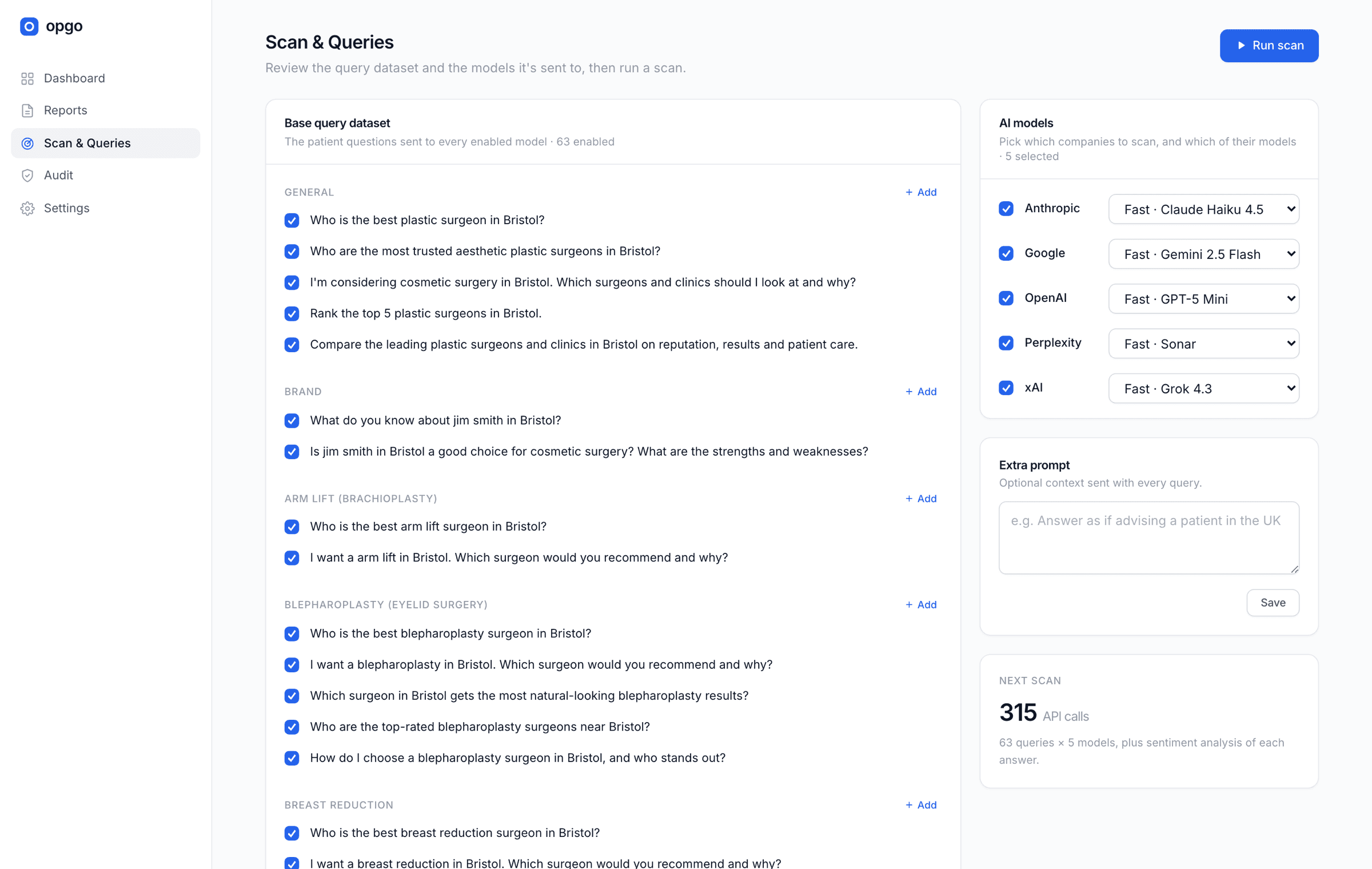
Your dataset
63 questions · 5 models
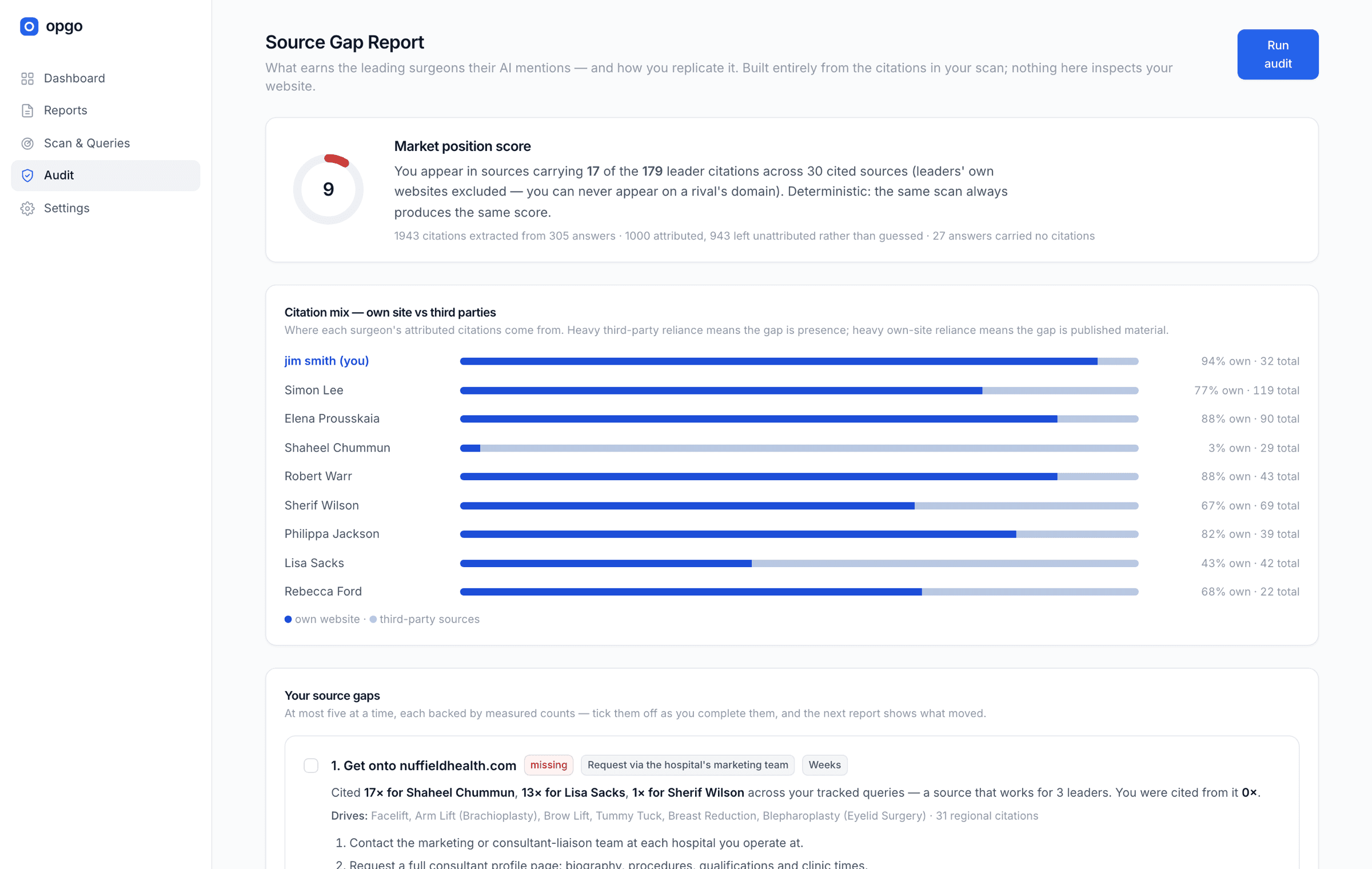
Smart fixes
15 prioritised, with evidence
We reverse-engineer the winners.
The audit doesn't guess. It crawls your site the way AI crawlers do, studies the exact pages the models cite for the leaders in your market, and turns the gap into a check-off list of fixes — from llms.txt and schema to the review platforms that actually get quoted.
AI-crawler access, schema and content checks on your site
The exact cited pages behind every winning competitor
A prioritised, trackable fix list — marked off as you go
The exact keywords don't matter.
The method does.
Ask an AI the same question twice and it changes its mind about one time in five. We know because we measured it — asking an identical question twice, the answers disagreed about whether a surgeon was named 18% of the time. That is the problem nobody else in this market will tell you about: if the question drifts and the model wanders, a change in your report means nothing.
So we ran the study. We rewrote a live practice's entire question set in ordinary patient language — no medical jargon, the way real people actually type — and put every version through five AI models, with the original wording run twice as a control to measure the noise floor. Rewording changed the results no more than asking the same question again. Competitor rankings held at a 0.84–0.95 correlation with roughly 90% overlap in the top ten, whichever words we used.
That is why OpGo is not a keyword tool. Chasing phrasing is chasing noise. What actually determines whether your reports can be trusted is the discipline underneath them — how questions are held constant, how every citation is traced back to the surgeon it supports, and how much of the data is thrown away rather than guessed at.
0
citations traced to source
every link the models read, attributed to a named surgeon
0.4%
attribution precision
audited against a hand-labelled set, every release
0%
of answers change on their own
the noise floor we measure against
0
AI models, every question
ChatGPT, Claude, Gemini, Perplexity, DeepSeek
Chasing keywords is a dead end
There is no magic phrasing that reveals your true position in AI search. Any tool selling you keyword optimisation for AI is selling you noise it cannot distinguish from signal — and has not measured the difference.
What matters is holding the question still
Every question is generated from a fixed template, engineered around your procedures, your priority operations and every market you work in — the same questions every month. When your numbers move, that is your visibility moving. Not the question.
Every citation is traced, or thrown away
We work down a ladder of evidence to decide which surgeon a cited page supports, and when nothing proves it we count it for nobody rather than guessing. Roughly half of all citations are discarded that way. The numbers you get are the ones we can show our working for.
Patients are already asking AI about you.
Find out what it says — and make sure the answer is your name.